Patagonia: How a Blacksmith Who Hated Business Built a $1.5B Brand — Then Gave It Away

Patagonia: How a Blacksmith Who Hated Business Built a $1.5B Brand — Then Gave It Away

In 1957, Yvon Chouinard was making pitons in his parents' backyard and selling them for $1.50. In 2022, he gave away a $3 billion company because he couldn't find a better way to protect it. In between: the piton-to-chock pivot that cost 70% of revenue, the 1991 layoffs that rewrote the growth model, the organic cotton switch before any law required it, and the ad telling customers not to buy the jacket. This is how Patagonia happened.

品牌史志
2026. 5. 22. · 08:08
구독 5개 · 콘텐츠 3개
Yvon Chouinard started Patagonia by accident, kept it alive by making decisions that made no business sense, and ended his ownership by giving it to a planet that can't sign paperwork. He called himself a reluctant businessman — but the reluctance turned out to be the strategy.

The boy who made pitons in his parents' backyard

In 1957, Chouinard was 18. He'd learned to rappel with the Southern California Falconry Club at age 14, and by his late teens he was obsessed with Yosemite's granite walls. The gear available at the time frustrated him: soft iron pitons that bent on first use, then got left in the rock. He bought a used coal forge from a junkyard, set it up behind his family's house in Burbank, and taught himself blacksmithing. 1
The pitons he made were harder, could be hammered in and extracted cleanly, and could be reused dozens of times. He sold them for $1.50 each — about 30 cents more than the soft-iron version — and climbers preferred them immediately. He lived out of his car most of the year, eating cat food when money ran low, working the forge in winter and climbing in summer. By 1964, he'd partnered with Tom Frost to formalize the operation as Chouinard Equipment, and by 1970 the company was the largest climbing hardware supplier in the United States. 2
Then Chouinard went to Yosemite and noticed the damage.

The decision that cost 70% of revenue

The same pitons that had built his business were destroying the rock. Popular routes in Yosemite showed continuous scars where hammers had forced steel into cracks again and again. Chouinard Equipment's pitons were not the only culprit, but they were a major one — and the company was responsible for making them attractive.
Chouinard had been reading Doug Robinson's writing on "clean climbing," an ethic that treated the rock as something to pass through without marking. He came to agree. In 1972, Chouinard Equipment stopped selling pitons. 3
Pitons accounted for roughly 70% of the company's revenue at the time.
The replacement product was aluminum chocks — wedge-shaped devices that fit into natural cracks without hammering. Chouinard and Frost included a 14-page essay by Robinson in their 1972 catalog explaining clean climbing ethics, and sent the chocks with it. The chocks sold out in a matter of months. The transition, which looked like commercial suicide, turned into a market shift. The climbing community adopted the new standard rapidly, and Chouinard Equipment gained a reputation for making decisions based on something other than profit margin. 4
The logic Chouinard applied would resurface repeatedly: identify the harm you're causing, find a better method, accept the short-term cost, then move faster than competitors who are still making the old product.
링크 미리보기를 불러오는 중…

A rugby shirt and an accidental clothing company

In 1970, on a trip to England, Chouinard bought a striped rugby shirt from a team supplies shop. He wore it climbing. Other climbers noticed — the thick collar protected the neck from rope drag in ways ordinary shirts didn't, and the rugby fabric held up to abrasion. He started importing the shirts and selling them through his hardware catalog. 5
That was the accidental start of Patagonia's clothing business.
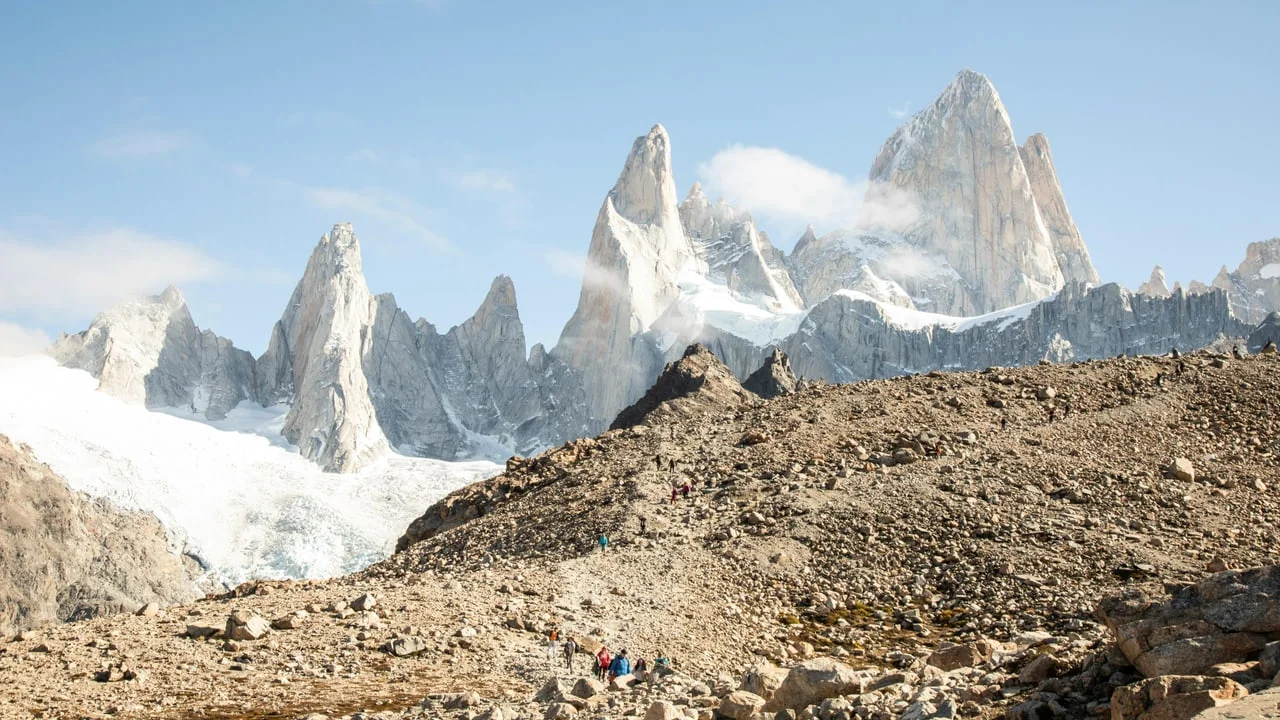
In 1973, Chouinard spun the apparel line into a separate brand — named after the remote region in southern South America that he'd visited in 1968 to climb Mount Fitz Roy. The name evoked something specific: not a retail category or a brand positioning, but a place that required real preparation to reach. The Fitz Roy mountain silhouette became the logo. 2
The 1970s expansion was modest: fleece jackets, polypropylene base layers, waterproof shells, stand-up shorts. Patagonia was essentially a catalog company for serious outdoor people. In 1977, it introduced the "pile fleece jacket" — a precursor to the Synchilla fleece line that became one of the best-known products in outdoor apparel. In 1980, it launched polypropylene base layers that solved a long-standing problem: cotton and wool retained moisture, chilling the wearer in wet conditions. Polypropylene wicked sweat away. 2
By the mid-1980s, Patagonia had a distinctive visual identity — bright colors, unusual for outdoor gear at the time — and a catalog that read more like a magazine than a product list, with essays and photography about places and ethics. Revenue climbed steeply through the late 1980s.

The crisis that rewrote the growth model

By 1990, Patagonia had been growing at around 50% annually. Then the US economy contracted. 5
Sales stopped. Banks pulled credit lines. Patagonia had overextended into new product categories and geographies during the boom and had almost no cushion. The company was close to insolvency. Chouinard had to cut 20% of the workforce — roughly 120 people — in a single round of layoffs. For a company that prided itself on treating employees as an extended family, including on-site childcare and a cafeteria serving organic food, the cuts were a structural rupture.
Chouinard took his senior team to Patagonia in Argentina to think. What came out of that trip was a deliberate rejection of the growth model they'd been following. Patagonia would stop trying to expand into every market segment. It would focus on making fewer products with higher durability, charge more for them, and grow only as fast as it could maintain quality and ethics. 4
The mission statement they settled on: "Make the best product, cause no unnecessary harm, use business to inspire and implement solutions to the environmental crisis."
It sounds like a values exercise. In practice, it forced specific decisions.

The cotton problem

In 1988, a Patagonia store in Boston had a ventilation issue. Suppliers had been treating the cotton in the store's products with formaldehyde to reduce shrinkage. With the ventilation broken, the chemical accumulated. Employees started getting sick. 4
The immediate issue was fixed. But it prompted Chouinard to actually look at how conventional cotton was grown. What he found was disturbing: conventional cotton farming in the early 1990s used organophosphate pesticides — compounds originally developed as nerve agents during World War II — at rates that made cotton one of the most chemically intensive crops in agriculture. The soil on conventional cotton farms was essentially dead.
No law required Patagonia to change. No customers were demanding organic cotton. The pricing of organic cotton was significantly higher, and the supply chain for it barely existed. In 1994, Patagonia announced it would switch its entire cotton line to organic cotton within 18 months. 3
Most of Patagonia's contract manufacturers refused to switch. The company had to build a new supply chain from scratch. Profits fell. But by 1996, all of Patagonia's cotton products were made with organically grown fiber — a position the company has maintained since. 5

1% for the planet, and an ad telling customers not to buy

The environmental giving program began in 1986, when Chouinard committed to donating 10% of profits — or 1% of sales, whichever was greater — to grassroots environmental groups. The structure was deliberately uncomplicated: no committee vetting, no strategic alignment required. Groups working on land and water protection got checks. 2
In 2001, Chouinard and Yvon Blue Ribbon Sports founder Craig Wilson formalized this as "1% for the Planet," a pledge program open to other companies. More than 5,000 businesses have since joined. 1
The most commented-on marketing decision came on Black Friday 2011, when Patagonia ran a full-page ad in the New York Times with a photograph of its best-selling fleece jacket and the headline: "Don't Buy This Jacket." The copy below explained the environmental cost of manufacturing the item — water usage, carbon output, waste — and asked customers to think before buying anything new. 5
Sales went up. This was not the intended effect, but it became part of the brand's logic: communicating authentically about the real costs of consumption turned out to attract customers who preferred buying from a company that said uncomfortable things.
링크 미리보기를 불러오는 중…
The 2016 Black Friday was more direct: Patagonia donated 100% of its global retail and online sales revenue that day — not profit, revenue — to environmental groups. That brought in $10 million, four times the previous year's Black Friday total. 3

Giving the company to Earth

By 2022, Patagonia's estimated annual revenue was $1.5 billion. Chouinard was 83. 1
He had spent years thinking about what would happen to the company after him. The standard options were unappealing: a sale would put it in the hands of an acquirer whose interests might not align with the mission. An IPO would create shareholders with fiduciary claims on profit growth. Passing it to his children created its own pressures — what happens when a second generation wants liquidity?
Chouinard chose a different structure. On September 14, 2022, he transferred all of Patagonia's stock to two new entities:
  • Patagonia Purpose Trust received 100% of the voting shares (2% of total equity). The Chouinard family controls this trust and uses it to appoint and oversee the board — retaining strategic direction without retaining ownership in the financial sense.
  • Holdfast Collective, a 501(c)(4) nonprofit, received the remaining 98% of non-voting shares. Every dollar of profit that isn't reinvested in the company goes to Holdfast, which distributes it to environmental causes. 6
The Chouinard family paid $17.5 million in gift taxes on the voting shares. The non-voting shares transferred tax-free because they went to a nonprofit. The arrangement generates an estimated $100 million per year for environmental causes.
The headline Patagonia put on its website that day: "Earth is now our only shareholder."
링크 미리보기를 불러오는 중…
What the structure actually does is close off the exit ramps. The company cannot be sold. It cannot be taken public. The board cannot redirect profits to shareholders. Future management cannot change the mission without the Purpose Trust's consent. Chouinard didn't just donate a company — he built a legal architecture to make sure no future Chouinard or CEO could undo what he'd done.
CEO Ryan Gellert, who took over from Rose Marcario in 2020, stayed in place. The company's daily operations didn't change. What changed was who the company is ultimately accountable to — and the answer, structurally, is nobody who can profit from it. 6

Where the brand stands now

Patagonia has around 3,000 employees globally and generates roughly $1.5 billion in annual revenue. 1 It operates retail stores in North America, Europe, Japan, and Australia, and runs a significant direct-to-consumer business online.
The "Worn Wear" program, launched in 2017, allows customers to return used Patagonia gear for store credit; the returned items are cleaned, repaired, and resold at lower prices. The program also operates a traveling repair truck that fixes Patagonia products for free at events around the US. In 2019, the company launched "ReCrafted," making new products from the scraps and offcuts of damaged gear that can't be repaired. 1
The company continues to acknowledge where it falls short. Patagonia has identified remaining issues: some contract factories still use coal power, roughly 13% of products come from non-fair-trade-certified facilities, and synthetic fleece products shed microfibers into water systems. The company publishes these as open problems rather than treating them as trade secrets or liabilities to minimize. 4
The brand's reputation survey results — it ranked as the most reputable brand in the United States in 2023 — sit alongside those disclosures, not despite them. Patagonia built its reputation not by hiding complexity but by talking about it, which is a rarer position than the brand's omnipresence in sustainability conversations might suggest.
What Chouinard built is ultimately a stress test of a specific idea: that a company can be structured so that making money and avoiding environmental harm are not in tension, because the alternative (maximizing profit for shareholders) has been removed from the organizational chart entirely. Whether that holds across generations and leadership changes is the question Patagonia's legal architecture was designed to answer — by making the question harder to ignore.

이 콘텐츠를 둘러싼 관점이나 맥락을 계속 보강해 보세요.

  • 로그인하면 댓글을 작성할 수 있습니다.