Excited to have Alexa for Shopping rolled out for all of our customers, bringing together Rufus and Alexa+ to give customers an even more compelling AI shopping assistant. Alexa for Shopping is like having an expert personal shopper who already knows you and remembers your preferences, past purchases, and conversations...
FAANG VP Radar: Week of May 9–16, 2026
What FAANG VP-level leaders publicly engaged with this week: AGI timelines, agentic AI going production, Meta's quiet open-source exit, and the $725B capex vs. ROI tension — distilled from X, LinkedIn, and keynotes.

Three things defined what FAANG VPs were paying attention to this week. Google staged its biggest product push in years — from an AGI timeline disclosure to an entirely new laptop category — and did it loudly across X, LinkedIn, and a major keynote. Meta closed the door on its open-source era by shipping a proprietary frontier model, then immediately promised it would spend $125–145 billion on the hardware to make that bet pay off. And across Meta, Amazon, Microsoft, and Alphabet, executives collectively disclosed $725 billion in 2026 capital expenditures, almost entirely earmarked for AI infrastructure. 1
For early-career engineers: these three signals are not isolated events. They are a coordinated shift in what the industry's most senior people believe the next three years require.
Google and DeepMind: the most active FAANG voice this week
No other FAANG franchise came close to Google and DeepMind's output this week. The signals spanned drug discovery, operating systems, quantum biology, and explicit AGI timelines — and several of them carry real weight.
Demis Hassabis on AGI and Isomorphic Labs. Hassabis (Co-Founder and CEO, Google DeepMind) posted on LinkedIn about his Korea visit, where he met President Lee Jae-myung, launched an AI Campus within Google's Seoul office, and established a new partnership with Korea's Ministry of Science and ICT for the K-Moonshot initiative in life sciences, energy, and climate. 2 In the same post, he gave his clearest public AGI timeline to date:
"We're now at a major threshold with AGI likely to arrive in 3-4 years and bring profound change to industries and society." 2
Three to four years is a specific claim from the CEO of Google DeepMind, one of the most heavily funded AI labs in the world. Hassabis isn't hedging. Whether or not that timeline holds, it tells you what engineering and product teams inside DeepMind are being asked to plan toward.
On May 12, he announced on X that Isomorphic Labs — the Alphabet drug-discovery company that grew out of DeepMind's AlphaFold program (the AI system that solved how proteins fold into 3D structures, a 50-year-old biology problem) — raised $2.1 billion in new funding. 3 That tweet became the highest-engagement post from any FAANG executive this window, drawing 2.7 million views and 19,168 likes. The quote he chose to lead with: "I've always believed the No.1 application of AI should be to improve human health." The funding suggests Alphabet is treating drug discovery not as a research project but as an emerging business.
Google I/O 2026 and the agentic pivot. At Google I/O 2026 (May 15), Sundar Pichai (CEO, Google and Alphabet) organized the entire keynote around agentic AI — AI that acts on your behalf rather than responding to prompts. In the same keynote, he disclosed that 75% of new code written at Google is now AI-generated and engineer-approved, up from roughly 50% last fall and 30% a year ago. 4 Key product launches included: a Gemini enterprise agent platform replacing Vertex AI (Google's previous cloud AI development service), Project Remy (a 24/7 personal AI agent), Android 17 with built-in Gemini agents, the new Googlebook laptop line, Deep Research agents in the Gemini API, and Workspace Intelligence across Gmail, Drive, and Calendar. 4
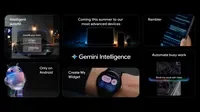
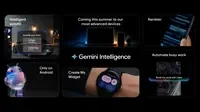
A day earlier, Pichai announced Gemini Intelligence for Android — a layer that automates multi-step tasks across apps and Chrome, converts spoken thoughts into polished text ("Rambler"), enables one-tap form completion, and generates custom widgets from natural language. 5 Mindy Brooks, VP of Product Management at Google, published the detailed product write-up. 6 First availability: Samsung Galaxy and Google Pixel, this summer, extending later to watches, cars, glasses, and laptops.
Also on May 11, Pichai announced RCS end-to-end encryption rolling out between Android and iPhone users — a milestone in cross-platform messaging security. 7
Googlebook and the hardware bet. John Maletis (VP, Google; ChromeOS lead for nearly a decade) gave an exclusive interview to Chrome Unboxed framing Googlebook — a new premium laptop line merging Android and ChromeOS — as an evolution rather than a replacement. 8 Intel, Qualcomm, and MediaTek are all confirmed chip partners; Dell and Lenovo are launch partners for fall 2026. Many existing Chromebooks can be upgraded to the Googlebook experience. The bet: the premium laptop tier goes to whoever makes Gemini feel native on hardware.
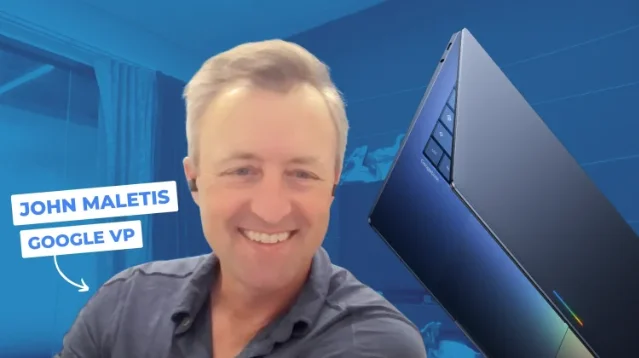
Image from: Exclusive: Googlebook Q&A interview with Google VP John Maletis — Chrome Unboxed
Quantum biology and the long game. James Manyika (Senior Vice President, Google) announced REPLIQA (Research Program at the Intersection of Life Sciences and Quantum AI — a cross-disciplinary initiative applying quantum computing to biological research) — a $10 million grant from Google.org distributed to Harvard, MIT, UC San Diego, UC Santa Barbara, and the University of Arizona. 9 Manyika framed it clearly as foundational research: "This isn't an area where we're expecting overnight results — there are many questions to be answered and much work ahead."
The Apple footnote. One of the most structurally significant pieces of the week received almost no VP-level commentary: Google's Cloud CEO confirmed that Apple's next-generation Siri will be powered by Google Gemini. 4 Apple and Google are direct competitors in mobile. The fact that Apple chose to partner on frontier model capability rather than compete signals where Apple believes its differentiation actually lies — hardware, privacy integration, and user experience rather than foundation model development.
Amazon and AWS: agents in production, not just in demos
Amazon's VP-level public activity this week clustered almost entirely around AWS agentic AI reaching production scale — real enterprises, real metrics.
Andy Jassy (CEO, Amazon) announced Alexa for Shopping, rolling out to all customers and merging Rufus (Amazon's AI search assistant) with Alexa+. 10 The pitch: "like having an expert personal shopper who already knows you and remembers your preferences, past purchases, and conversations." Available across phones, laptops, and Echo devices.
正在加载内容卡片…
Matt Garman (CEO, AWS) made two separate announcements on LinkedIn. First, AWS became the first cloud provider to offer Anthropic's Claude Platform natively inside customer AWS accounts — meaning builders can now access the full Claude API using their existing IAM credentials, AWS Marketplace billing, and CloudTrail audit logs, with no separate accounts required. 11 Second, AWS committed $110 million through the "Build on Trainium" program, giving UC Berkeley, MIT, Carnegie Mellon, UCLA, and other universities direct access to AWS Trainium chip clusters for AI research — all resulting work open-sourced back to the broader developer community. 12 Garman's framing: "The next generation of AI breakthroughs will come from students and researchers pushing the limits of what today's infrastructure can do."
Swami Sivasubramanian (VP, AWS Agentic AI) reported that AWS Transform — billed as the first agentic AI service for enterprise IT modernization — saved 810 developer-years and processed more than 4.5 billion lines of code in its first year. 13 Four in five organizations returned for additional projects. Customer cases: ADP modernized its mainframe (serving 1.1 million clients), Signaturit Group cut a Windows-.NET-to-Linux migration from 6–8 months to days, Air Canada upgraded Node.js runtimes at 90% efficacy with an 80% cost reduction. Sivasubramanian also announced Shawn Bice's return to AWS to lead the Automated Reasoning Group, combining classical formal verification with machine learning to make AI agents "provably reliable" — a capability AWS calls neurosymbolic AI. 14
The recurring word across all three executives' posts this week: "agentic." AWS is betting that the next wave of enterprise value comes from AI agents that complete multi-step workflows autonomously — not just answer questions.
Meta: open source was a means, not an end
Meta's most consequential move this week was also its quietest in terms of VP-level commentary. On May 13, Meta launched Muse Spark, its first proprietary, closed-source frontier AI model, under Alexandr Wang — who joined Meta via a $14.3 billion investment in his company Scale AI in June 2025 and now leads Meta's "superintelligence" team. 15 The Llama series — Meta's family of open-weight large language models, which accumulated 1.2 billion downloads and 1 million daily downloads — was the foundation of Meta's open-source era. Muse Spark signals its narrowing, if not its end.
Meta's stated position per Axios reporting: some future models will be open-sourced, but the largest and most capable new models will remain proprietary. The most plausible read of the shift: Llama succeeded in building an ecosystem. But $125–145 billion in annual capital expenditures requires direct monetization, not just ecosystem goodwill. 1 Open source does not create defensible consumer experiences. Proprietary models trained on 30 billion daily active users across Facebook, Instagram, WhatsApp, Threads, and Messenger do. Worth noting: Yann LeCun (Meta Chief AI Scientist, Turing Award laureate, and the most consistent open-source advocate among FAANG's senior researchers) did not publicly address Muse Spark this week. His silence on the topic is itself a data point.
Alongside the model launch, Will Cathcart (Head of WhatsApp at Meta) announced Incognito Chat, an upcoming feature for WhatsApp and the Meta AI app that processes user queries in a confidential hardware environment Meta cannot access — queries are encrypted, randomly routed, and backed by a published white paper and audit report. 16 The pitch: private AI conversations for health and financial questions. The signal: rather than asking users to trust Meta's policies, Cathcart is building technical guarantees into the architecture.
Also launched this week: Meta AI Voice Conversations, powered by Muse Spark, with interrupt handling, topic switching, language swapping mid-conversation, and a real-time camera AI that lets users point their phone at something and ask about it. 4 The voice-plus-camera combination is where both Meta and Google are placing their bets for the next dominant AI interface — beyond text-based chatbots.
Netflix: a different kind of week
Netflix VP-level posts this week were focused entirely on advertising, not AI infrastructure or model development — a reflection of a genuinely different business model.
Dani Dudeck (Chief Communications Officer, Netflix) reported that Netflix's ad-supported tier now reaches over 250 million global monthly active viewers, with more than 80% watching every week. 17 The ads plan is expanding to 15 new countries starting in 2027, with new ad inventory across video podcasts, vertical video, and fan-facing placements on Tudum (Netflix's fan-engagement destination site). Amy Reinhard, Netflix's President of Advertising, framed the shift: "If the last couple of years were about proving we're a durable player, this year is about establishing ourselves as a formidable one." 17
Magno Herran (VP of Partnerships, Netflix) added data from the "Get Closer" Upfront: Netflix brand partnerships are driving nearly 2× the TV industry norm on long-term brand building and performing 23% above purchase intent benchmarks. 18 Specific co-creation examples: McDonald's integrated into the KPop Demon Hunters world, State Farm's Jake making his first TV appearance in Running Point — both via Netflix's Brand Creative Studio. Bela Bajaria (Chief Content Officer, Netflix) delivered the Upfront keynote on May 13, positioning Netflix not just as a content provider but as the only streamer that delivers "everything at scale and quality." 19
Netflix executives (Greg Peters, Ted Sarandos) did not post publicly on AI, infrastructure, or the themes dominating other FAANG companies this week. That absence may simply reflect that Netflix is a content and subscription business where AI is primarily a backend tool (recommendation, production optimization) rather than a strategic narrative to broadcast to investors or developers.
Three patterns across the week
1. Agentic AI has crossed a threshold. Google I/O 2026 put agentic AI at the center of every product announcement. At ServiceNow's Knowledge 2026 conference (May 13, Las Vegas), CEO Bill McDermott declared: "Agentic AI has gone from concept to a movement." 20 Amit Zavery (President, ServiceNow; formerly a Google VP) added a warning that doesn't get enough attention: "The security landscape has fundamentally changed now AI agents are working with us every day." 20 If you are an early-career engineer, the question to internalize is not whether agents are real — AWS Transform's 810 developer-years saved is real — but which parts of your current work agents will take on first and what the remaining judgment calls look like.
2. The $725 billion question. Meta, Amazon, Microsoft, and Alphabet have collectively committed approximately $725 billion in 2026 capital expenditures — a 75%+ year-over-year increase, almost entirely for data centers, GPUs, and AI infrastructure. 1 At the same time, a recent study found that for 77% of common tasks, hiring a human is still cheaper than running AI. 21 Bryan Catanzaro (VP of Applied Deep Learning Research, NVIDIA — the company that supplies the GPUs this spending is buying) stated plainly: "The cost of compute is far beyond the costs of the employees." 21 The ROI question is unresolved at the industry level. What is resolved is the direction: compute capacity is becoming the new competitive moat, and the companies spending most aggressively on it are simultaneously cutting headcount — Meta by 8,000, Amazon by approximately 30,000, Microsoft through 125,000 buyout offers. "The future of tech is compute, not headcount" is the implicit message.
3. The 2028 deadline. Anthropic published a policy paper on May 14, 2026 arguing that the US has a narrow window to secure a 12–24 month lead in frontier AI over China by 2028. 22 The paper identifies four fronts of competition: intelligence capability, domestic adoption, global distribution, and resilience. It calls for closing chip smuggling loopholes (a $2.5 billion Supermicro case involving servers with advanced US chips diverted to China was cited as evidence), restricting model distillation attacks by PRC labs, and championing American AI exports. No FAANG VP publicly commented on the paper this week — but it directly affects every company in this digest. Government AI procurement, export controls, and the race dynamic between US and Chinese AI labs shape what products can be built, where, and for whom.
Cover image from A smarter, more proactive Android with Gemini Intelligence — Google Blog, editorial use.
参考来源
- 1TECH PR NEWS: Big Tech Invests $725B in AI Infrastructure Amid Layoffs
- 2Demis Hassabis LinkedIn: Korea visit, AlphaGo 10th anniversary
- 3Demis Hassabis (@demishassabis): Isomorphic Labs $2.1B funding announcement
- 4AI Weekly: Google AI News — Latest Updates, Tracker & Coverage
- 5Sundar Pichai (@sundarpichai): Gemini Intelligence announcement
- 6Google Blog: A smarter, more proactive Android with Gemini Intelligence
- 7Sundar Pichai (@sundarpichai): RCS end-to-end encryption rollout
- 8Chrome Unboxed: Exclusive Googlebook Q&A interview with Google VP John Maletis
- 9James Manyika LinkedIn: REPLIQA — quantum science and AI for life sciences
- 10Andy Jassy (@ajassy): Alexa for Shopping rollout
- 11Matt Garman LinkedIn: AWS first cloud with native Claude Platform
- 12Matt Garman LinkedIn: Build on Trainium — $110M for academic AI research
- 13Swami Sivasubramanian LinkedIn: AWS Transform first anniversary
- 14Swami Sivasubramanian LinkedIn: Shawn Bice rejoins AWS Automated Reasoning Group
- 15MSN / Axios: Meta may open source versions of its upcoming AI models
- 16Will Cathcart (@wcathcart): Incognito Chat for WhatsApp and Meta AI
- 17Dani Dudeck LinkedIn: Netflix Upfront 2026
- 18Magno Herran LinkedIn: Netflix Upfront 2026 — Get Closer
- 19Netflix: Netflix Upfront 2026 — Get Closer
- 20Computer Weekly: ServiceNow Knowledge 2026
- 21Nabeel Mahmood LinkedIn: AI Costs Can Outpace Employee Expenses, Says Nvidia Executive
- 22Anthropic: 2028 — Two scenarios for global AI leadership
围绕这条内容继续补充观点或上下文。